Myndos, the Ancient City beneath Gümüşlük
Under Gümüşlük's restaurants and lanes lies Myndos, a Carian harbour city that held off Alexander the Great. What we know, and where to look for it.
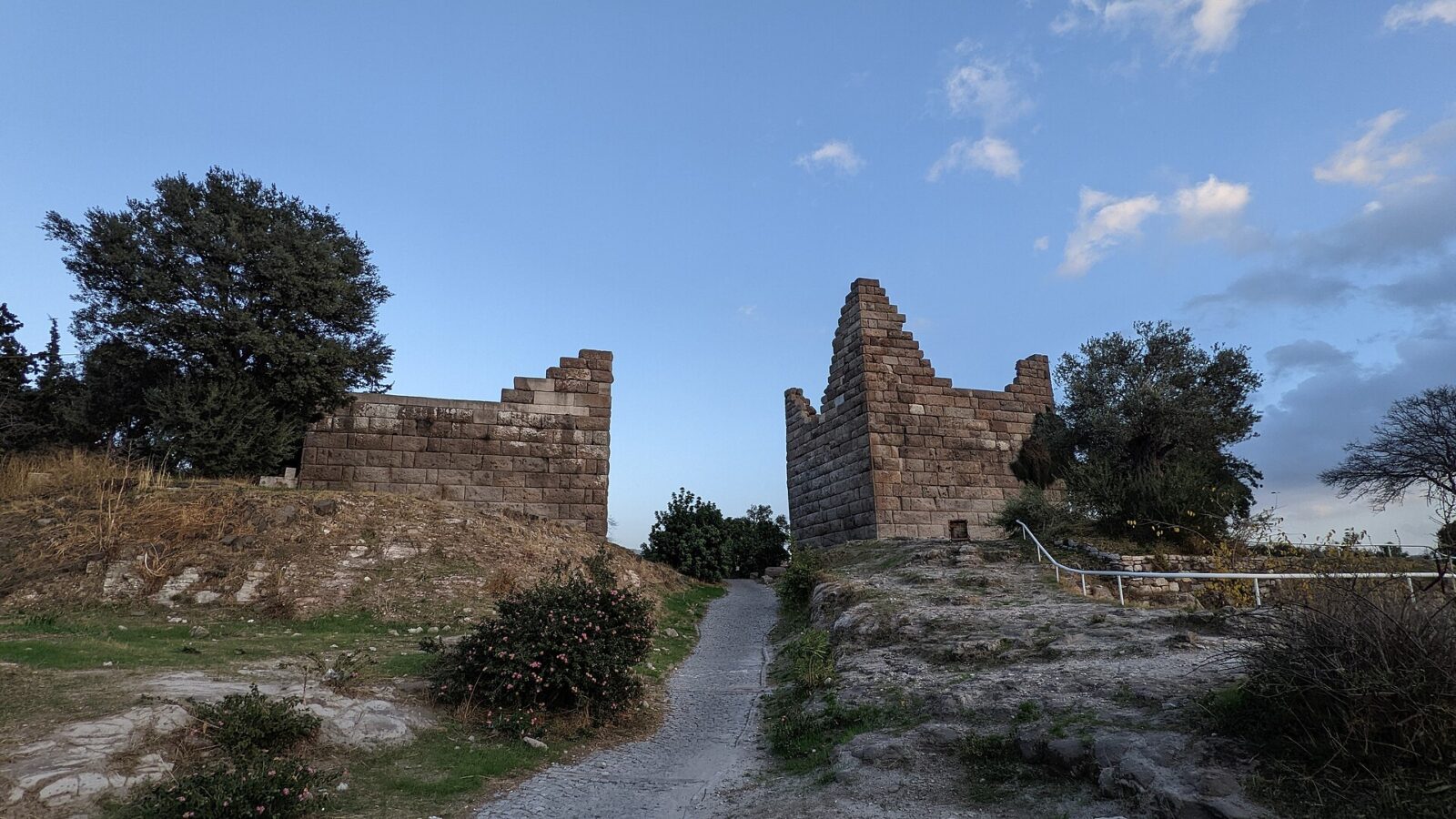
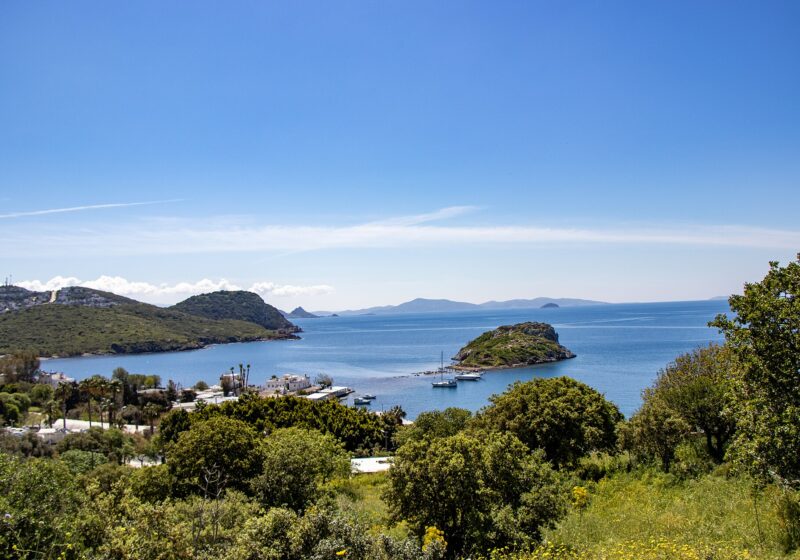
Every evening, people eat grilled fish on the Gümüşlük waterfront a few metres from the walls of a city that was already old when Alexander the Great marched past it. Myndos is not a fenced site with a ticket office. It is the ground the village stands on, scattered across the hillside, the island and the seabed.
This is a short guide to what Myndos was, what archaeologists have found and how to see it with your own eyes.
Before Myndos: the Lelegian hills
Long before the Greek city, the hills of the western peninsula belonged to the Leleges, a people the ancient writers counted among the native inhabitants of Caria. We know little about their language or culture, but they left their mark in heavy walls of large, irregular “polygonal” blocks on hilltops across the peninsula.
On Kocadağ, the 484-metre hill behind Gümüşlük, and on the slopes above the bay, stretches of this kind of wall survive. Pottery found in the area goes back at least to the Mycenaean period, and a marble statue of a young man (a kouros) from the sixth century BC shows the site mattered well before its best-known era. Ancient sources also mention a separate, older settlement called Palaemyndus (“old Myndos”), apparently abandoned once the coastal city took over.
A harbour city on the edge of Caria
Ancient writers describe Myndos as a colony from Troezen in the Peloponnese, with strong walls and a good harbour. It appears in Herodotus: a Myndian ship’s captain named Scylax was caught leaving his vessel unguarded during the Persian expedition against Naxos around 499 BC, and the quarrel that followed helped spark the Ionian Revolt.
In the fifth century BC Myndos paid into the Athenian-led Delian League. Underwater surveys of the eastern harbour have identified a massive stone mole, its top now lying just below the surface, which one researcher dates to this century on the basis of its building technique. The harbour mouth was narrow enough that a chain may have been stretched across it from a tower on the island.
Mausolus and the new city
The city that shaped Gümüşlük took form in the fourth century BC under Mausolus, the Carian ruler whose tomb in Halicarnassus (modern Bodrum) gave us the word mausoleum. Mausolus gathered the populations of many small peninsula towns into his new capital, but Myndos was kept and rebuilt, with new walls that ran down to the shore and out to the island.
The walls were apparently generous for the size of the town. The philosopher Diogenes is said to have visited and advised the citizens to shut their gates in case the city walked out through them.
They earned their keep in 334 BC. While besieging Halicarnassus, Alexander the Great tried to take Myndos by surprise. According to the historian Arrian, the defenders, reinforced by sea from Halicarnassus, drove him off with losses.
Good to know: The “Myndos Gate” you may see signposted in Bodrum town is not in Gümüşlük. It is a restored gate in the walls of ancient Halicarnassus, on the road that once led to Myndos, and it saw fighting during Alexander’s siege.
Roman, Byzantine and later
Myndos carried on through the Hellenistic and Roman centuries. An ancient writer praised the local wine as good for digestion, and olives and oil were part of its economy. In the Byzantine period it became the seat of a bishop; bishops of Myndos are recorded at church councils in 431 and 451, and the see appears in lists until around the twelfth or thirteenth century.
Excavations on the island have turned up later Roman and Byzantine buildings, graves and, more surprisingly, coins from the Seljuk period. The excavation director linked these to the arrival of Turkish groups on the peninsula in the late eleventh century.
What the excavations found
For a long time Myndos was known mainly from ancient texts and a few visible ruins. Systematic excavation began in the mid-2000s under Professor Mustafa Şahin of Uludağ University, after earlier rescue digs by the Bodrum Museum. In 2005 an inscription naming Myndian judges settled any lingering doubt that this was indeed the city.
Among the finds over the following years:
- Rock-cut tombs discovered during road widening on the Gümüşlük–Yalıkavak road, still holding glass and clay vessels and an oil lamp from around the first century AD.
- A harbour building with a vaulted roof and a mosaic floor, later paved with marble carved with crosses, tentatively dated to the fifth century AD.
- A probable bath building with marble cladding and waterproof mortar, later reused as a lime kiln.
- On Rabbit Island (Tavşan Adası), also called Asar Adası, a church with cisterns, graves, temple column fragments and remains of houses.
- A theatre, detected by geophysical survey in the hillside but not yet uncovered.
The city under the water
Parts of Myndos lie beneath the sea. An earthquake that no ancient writer recorded is thought to have dropped sections of the seafront below the waterline, and blocks from walls and buildings are scattered across the shallows.
In some winters the sea level drops noticeably, and more appears. In early 2025 Turkish press reported fourth-century BC wall foundations emerging between the shore and Rabbit Island as the water receded, drawing photographers down to the beach.
Loading the map…
Seeing Myndos today
There is no visitor centre, so you need to look for it:
- The crossing to Rabbit Island: wade the shallow strip and notice the cut blocks under your feet. Parts of the island are an excavation area and may be fenced. Our Rabbit Island walk has the practical details.
- The hillside above the bay: follow the paths and field walls to find polygonal walling, column drums built into terraces and the remains of an early church, probably fifth or sixth century AD.
- The waterfront itself: in calm water, look down near the harbour mouth for the line of the old mole.
Signage is sparse and paths can be overgrown. Go in the cooler hours, wear proper shoes and do not move or take any stones. Under Turkish law the whole area is protected, and removing even small fragments is a criminal offence.
A site still debated
Myndos sits inside a living village, and the balance between protection and building is a recurring argument. In 2013 several parcels were registered as a first-degree archaeological site, the strictest category. In 2022 a regional heritage board decision to allow test drilling on land outside the walls drew protests from archaeologists and residents, who feared it would open the way to construction. The issue comes up in the Turkish press from time to time.
Before you go
- Combine it: Myndos fits easily into a slow day in Gümüşlük, with a ramble in the late afternoon and dinner by the water.
- For context: The Museum of Underwater Archaeology in Bodrum Castle helps make sense of the region’s maritime past; see our Bodrum Peninsula overview.
- Bring: Water, a hat and shoes you can wade in and then walk uphill in.
- Respect the site: Do not climb on fragile walls, and stay out of fenced excavation areas.